In short: AI is not a threat to logos, colour palettes or visual identity systems. Those are well-documented and easy to defend. It is a threat to internal branding: the culture, voice and judgment that live inside a company and rarely get written down. That's what erodes first when AI becomes the default way people communicate.
The optimism isn't wrong. It's incomplete
Every current brand reference treats AI as a straightforward productivity story. It speeds up ideation, drafts copy, generates images, prototypes packaging. All of that is true, and I use these tools myself, every week.
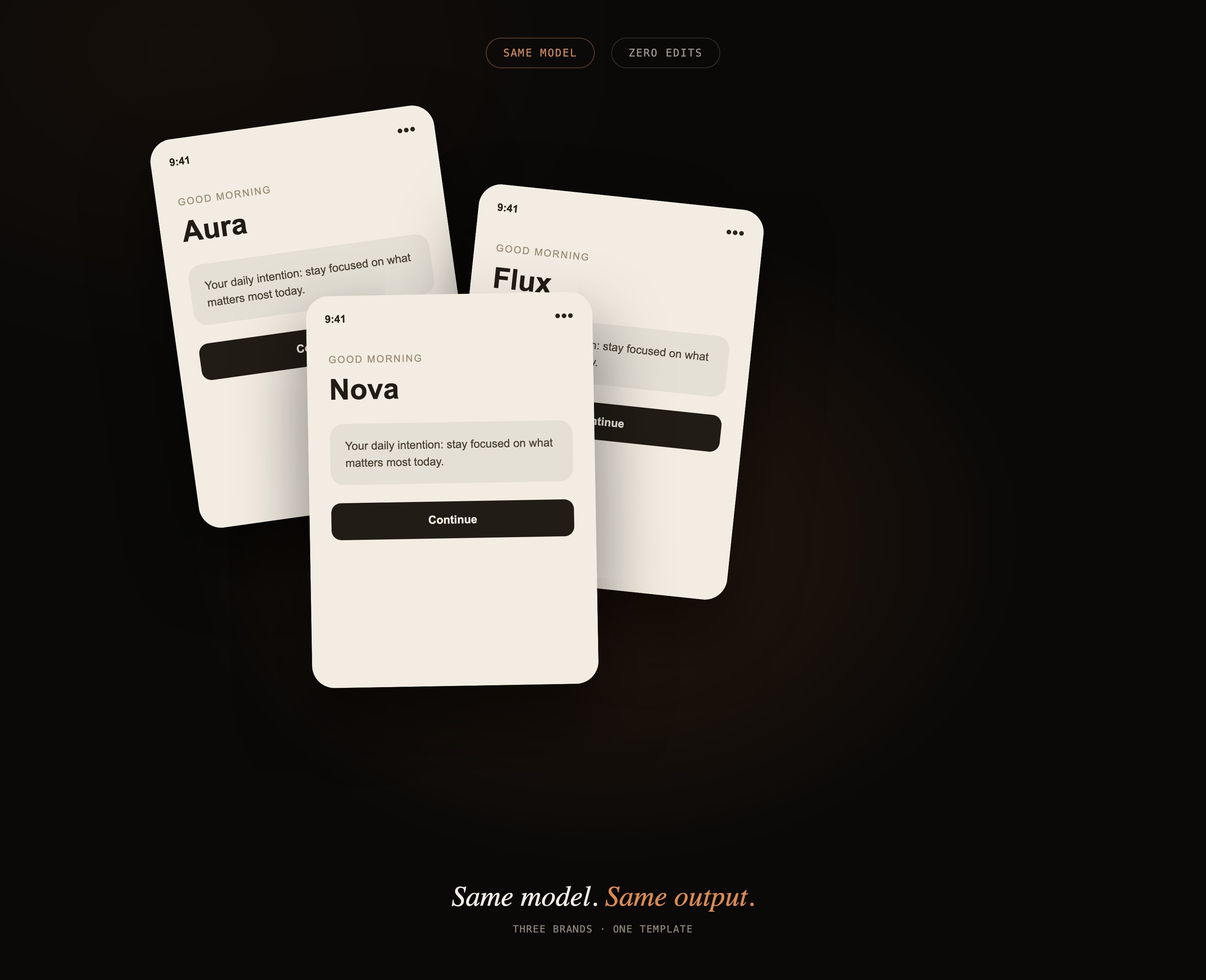
What that framing leaves out is a second-order effect: efficiency tools tend to converge on the same outputs when enough people use them the same way. A brand book can tell you AI will make your content more relevant and more personal. It won't tell you what happens to your voice when a hundred thousand other companies are asking the same models the same kinds of questions.
Same tools, same data, same voice
Large language models are trained on overlapping data, tuned toward similar defaults, and nudged by the same best-practice prompts circulating on every marketing blog. Ask five different companies' AI tools to write a mission statement, a LinkedIn post, or an onboarding email, and you'll get five variations of the same cadence, the same structure, the same safe adjectives.
None of it is wrong. It's just not distinctly anyone's. And distinctiveness, not correctness, is the entire job of a brand.
External identity is well-guarded. Internal branding isn't
Most companies have a visual identity system: logo usage rules, colour values, typography, a reviewer who says no to the wrong shade of blue. Almost none have an equivalent system for how the company sounds and behaves on the inside: in Slack messages, internal decks, town-hall scripts, performance reviews, the way a manager explains a decision to their team.
That gap used to be harmless, because internal communication was slow and human by default. AI removes the friction that used to protect it. The fastest way to write an internal update is now to ask a model, and the model doesn't know your culture. It knows the average of everyone's.
What internal branding actually is
Internal branding is not a poster in the break room. It's the accumulated judgment a company has about itself: what a "good" decision sounds like here, what gets celebrated, what gets quietly corrected, how directly people are allowed to disagree. Employees absorb it by watching real examples over time, not by reading a values statement.
It is, in other words, exactly the kind of thing a general-purpose model cannot know unless someone has deliberately taught it. That's a governance problem, not a prompting problem.
Why it erodes faster than a logo does
A misused logo gets caught, because someone is watching for it. A slightly generic internal memo doesn't get caught, because nobody is auditing tone on a document nobody outside the company will ever see. Multiply that by every manager, every market and every AI-assisted draft, and the culture's voice drifts toward the model's default without a single visible failure to point to.
By the time it's noticeable (new hires who sound like they learned the company from a chatbot, decks that could belong to any competitor), it's no longer a writing problem. It's an identity problem.
What this looks like in practice
In my work training multicultural Design teams across 16 countries, the hardest thing to transmit was never a colour value or a grid system. Those travel well in a PDF. What doesn't travel automatically is judgment: knowing when a layout is "on brand but boring" versus "on brand and confident," a distinction no guideline fully captures.
The teams that kept a strong, recognisable voice weren't the ones who avoided AI. They were the ones who fed it real internal examples, real decisions and the reasoning behind them, instead of letting it default to generic best practice. The tool didn't replace the culture. It had to be taught the culture first.
A practical checklist
- Write down the internal voice the same way you document the visual identity: with real examples, not adjectives.
- Before rolling out AI writing tools internally, feed them your own decisions, memos and feedback, not generic prompts.
- Audit a sample of AI-assisted internal communication the way you'd audit external brand compliance.
- Protect a few deliberately human touchpoints (onboarding conversations, difficult feedback, culture-defining decisions) where a model shouldn't draft the first version.
- Treat "this sounds like it could be from any company" as a warning sign, not a neutral outcome.
The visual identity is the part of a brand everyone is watching. Internal branding is the part nobody audits. That's exactly why, in the age of AI, it's the part most likely to quietly disappear.
Frequently asked questions
It can. When many companies use the same tools, trained on overlapping data and guided by the same best-practice prompts, the output converges on the same cadence, structure and safe adjectives. The result is correct, but not distinctly anyone's.
Internal branding: the culture, voice and judgment that live inside a company and rarely get written down. Visual identity is well documented and audited; internal communication usually is not.
Document the internal voice with real examples, feed AI tools the company's own decisions, memos and feedback instead of generic prompts, audit a sample of AI-assisted internal communication, and keep a few touchpoints deliberately human, such as onboarding conversations and difficult feedback.